
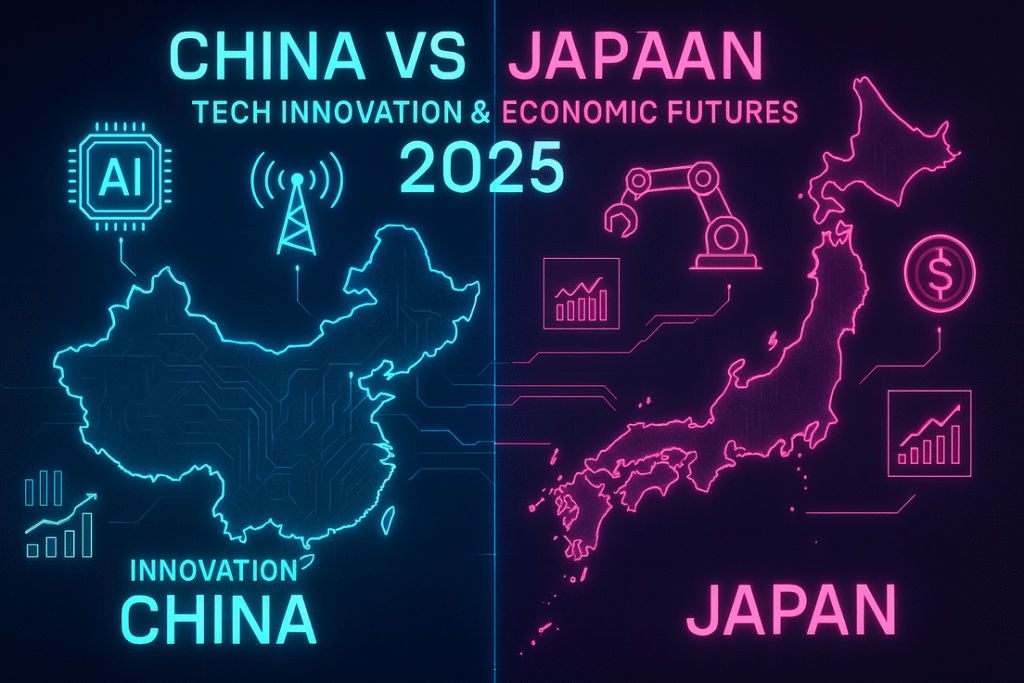

China vs Japan 2025 – Pioneering Tech Innovation & Economic Triumphs and Hurdles
The 21st century has been dubbed the “Asian Century,” and at its heart lies one of the world’s most compelling and consequential rivalries: China versus Japan. This is not a story of mere economic competition; it is a grand narrative of two distinct civilizations, with contrasting political systems and societal models, vying for supremacy in the realm of technology and global influence. As we navigate through 2025, this rivalry has entered a new, more complex phase. It’s no longer just about GDP size or export volumes; it’s about who will set the standards for the technologies of tomorrow—from artificial intelligence and quantum computing to next-generation mobility.

This in-depth analysis will dissect the pioneering technological innovations and economic triumphs of both China and Japan, while also shedding light on the profound hurdles each nation must overcome. We will move beyond the headlines to understand the core strategies, strengths, and vulnerabilities that will define the future of these Asian powerhouses.
The Chinese Juggernaut: Scale, Speed, and State-Driven Ambition
China’s economic miracle over the past four decades is unparalleled in modern history. Having overtaken Japan as the world’s second-largest economy over a decade ago, its ambitions have only grown. The “made in china initiative, though less publicly mentioned now, continues to be the strategic blueprint, aiming to transform China from a manufacturing hub into a global leader in high-tech industries.
Triumphs in Tech Innovation:
-
Artificial Intelligence (AI) Dominance: China is in a head-to-head race with the United States for AI supremacy. The country boasts a unique trifecta: vast amounts of data from its 1 billion+ internet users, a thriving ecosystem of tech giants like Baidu, Alibaba, and Tencent (BAT), and unwavering government support. Chinese AI applications are already world-leading in areas like facial recognition, fintech, and smart city management. The focus for 2025 is on developing foundational AI models and achieving self-reliance in core AI chips.
-
The Electric Vehicle (EV) Revolution: This is perhaps China’s most visible global success story. Companies like BYD, Nio, and XPeng have not only captured the massive domestic market but are now exporting competitively priced, high-quality EVs to Europe and Southeast Asia. China has built an entire ecosystem around EVs, from dominating battery production (with firms like CATL) to securing critical mineral supply chains. In 2025, the focus is on autonomous driving capabilities and solid-state battery technology.
-
Semiconductor Self-Sufficiency Push: Recognizing its critical vulnerability, China is investing astronomical sums—hundreds of billions of dollars—into building a fully domestic semiconductor industry. While still behind global leaders like TSMC and Samsung in cutting-edge chip manufacturing, China is making significant strides in mature node technologies and chip design. The national mission is to circumvent foreign sanctions and achieve technological sovereignty.
-
Digital Currency and Fintech: The Digital Yuan (e-CNY) is a pioneering project that could reshape global finance. By creating a central bank digital currency (CBDC), China aims to increase financial inclusion, improve monetary policy efficiency, and challenge the US dollar’s dominance in international trade. Its advanced digital payment infrastructure is already a model for the world.
Economic Hurdles and Challenges:
-
The Demographic Time Bomb: China’s population is now shrinking and aging rapidly, a direct consequence of its former one-child policy. This leads to a shrinking workforce, rising labor costs, and an immense pressure on the pension and healthcare systems. Reversing this trend is a monumental task that no country has successfully accomplished.
-
The Property Market Crisis: The once-booming real estate sector, which accounted for nearly 30% of GDP, is in a severe downturn. The defaults of giants like Evergrande and Country Garden have eroded consumer confidence, crippled local government finances, and created a significant drag on economic growth.
-
Geopolitical Tensions and “De-risking”: The US-led strategy of “de-risking” has prompted many Western companies to diversify their supply chains away from China. This “China Plus One” strategy, coupled with stringent export controls on advanced technology, threatens to slow China’s access to foreign innovation and markets.
-
Debt and Structural Imbalances: China’s total debt, including corporate, household, and government debt, is exceptionally high. Managing this debt burden without triggering a financial crisis, while simultaneously trying to rebalance the economy from investment-led to consumption-driven growth, is a delicate and critical challenge.

The Japanese Phoenix: Precision, Quality, and Strategic Reinvention
Japan, the former Asian economic titan, has battled deflation and stagnation for decades. However, to write off Japan would be a grave mistake. The nation is in a period of strategic reinvention, leveraging its unparalleled strengths in manufacturing, materials science, and corporate resilience to stage a remarkable comeback.
Triumphs in Tech Innovation:
-
Legacy in Semiconductors and Materials Science: While Japan lost its lead in chip manufacturing, it remains an indispensable player in the global semiconductor supply chain. Companies like Tokyo Electron and Shin-Etsu Chemical are world leaders in semiconductor production equipment and essential materials like silicon wafers and photoresists. Japan’s strategy is to reclaim its glory through massive investments in new foundries, like the Rapidus Corporation, which aims to produce 2nm chips by 2027 in partnership with IBM and Imec.
-
Robotics and Advanced Manufacturing: Japan is the undisputed global leader in industrial robotics. Brands like Fanuc, Yaskawa, and Epson are at the core of smart factories worldwide. In 2025, the focus is on collaborative robots (cobots) that work safely alongside humans and robotics for eldercare and healthcare, addressing domestic needs while creating a massive export opportunity.
-
Battery Technology and Hydrogen Economy: While China leads in current EV battery production, Japan is betting heavily on the next frontier. Toyota is a global pioneer in hydrogen fuel cell technology and is aggressively developing solid-state batteries, which promise longer range, faster charging, and greater safety. If successful, this could be a game-changer, allowing Japan to leapfrog the current battery technology cycle.
-
Stealthy Digital Transformation: Japan’s digital transformation, or “DX,” has been slower than China’s, but it is now accelerating rapidly. The government’s “Digital Garden City Nation” vision aims to digitize all aspects of society, from local government services to agriculture. Furthermore, Japan retains a strong position in niche, high-value digital fields like gaming, animation, and high-performance computing.
Economic Hurdles and Challenges:
-
The Super-Aged Society: Japan’s demographic challenge is the most advanced in the world. With over 29% of its population aged 65 or older, the strain on the social security system is immense. The shrinking and aging population constricts the domestic market and creates a severe labor shortage, necessitating a controversial but necessary reliance on immigration and robotics.
-
Stagnant Wages and Deflationary Mindset: After decades of deflation, a “deflationary mindset” has become entrenched among Japanese consumers and corporations. Companies are hesitant to raise prices, and workers are hesitant to demand higher wages, creating a vicious cycle that has stifled domestic consumption and economic vitality.
-
High Public Debt: Japan holds the highest public debt-to-GDP ratio of any developed nation, currently over 260%. While this debt is largely domestically owned, it limits the government’s fiscal flexibility and poses a long-term risk to economic stability.
-
Corporate Culture and International Competition: Traditional Japanese corporate culture, with its emphasis on seniority and lifetime employment, can sometimes hinder the agility and risk-taking needed in today’s fast-paced global tech landscape. Fostering a more entrepreneurial and dynamic startup ecosystem is a key challenge.

Head-to-Head in 2025: The Key Battlegrounds
The competition between China and Japan is not a zero-sum game, but their strategies directly clash in several critical domains:
-
Semiconductors: China is pushing for self-sufficiency from the ground up, while Japan is leveraging its existing, critical niche expertise to reclaim a leading position in advanced manufacturing. The battleground is in the machinery and materials that make chips possible.
-
EVs and Future Mobility: China dominates the mass EV market. Japan’s counter is a multi-path strategy, perfecting hybrid technology (where it still leads), advancing hydrogen fuel cells, and racing to commercialize solid-state batteries. The winner of the solid-state battery race could redefine the entire automotive industry.
-
AI and Robotics: China excels in AI software and data-centric applications. Japan’s strength lies in the physical embodiment of AI—advanced, precise robotics. The synergy is obvious, and we may see collaborations, but the strategic competition is about which model of automation becomes the global standard.
-
Regional Influence: Through its Belt and Road Initiative (BRI), China has expanded its economic and political influence across Asia and Africa. Japan counters with a strategy focused on high-quality infrastructure investment, transparency, and “soft power,” positioning itself as a reliable, democratic partner in the Indo-Pacific region.
Frequently Asked Questions (FAQs)
Q1: Who has a stronger economy in 2025, China or Japan?
A: In terms of sheer size (Nominal GDP), China’s economy is significantly larger than Japan’s. However, economic strength is multi-faceted. Japan often ranks higher in terms of GDP per capita (a measure of average wealth), technological sophistication in specific niches, and the global reach of its brands. China’s strength lies in its massive scale, rapid growth in new sectors like EVs, and its vast domestic market.
Q2: Which country is more technologically advanced?
A: It depends on the sector. China has a clear lead in the scale and application of digital technologies like e-commerce, fintech, and AI-driven surveillance. Japan maintains a dominant lead in high-precision fields like industrial robotics, semiconductor manufacturing equipment, and advanced materials science. They are advanced in different, complementary ways.
Q3: What is the biggest threat to China’s economic growth?
A: The most significant interconnected threats are its demographic decline and the property market crisis. A shrinking workforce undermines long-term growth potential, while the property slump threatens financial stability and consumer confidence, creating a powerful headwind for the economy.
Q4: How is Japan dealing with its aging population?
A: Japan is employing a dual strategy. First, it is increasingly relying on immigration to fill labor gaps, though policy remains cautious. Second, and more prominently, it is pushing automation and robotics to an extreme, developing robots for manufacturing, logistics, and even eldercare to compensate for the lack of human workers.
Q5: In the EV race, is Japan falling behind?
A: In the current mass market for battery electric vehicles (BEVs), yes, Japan is behind China. However, Japan is not conceding the race. Its strategy is focused on a “multi-pathway” approach, including perfecting hybrids (where it leads), pioneering hydrogen fuel cell vehicles, and investing heavily in the next generation of solid-state batteries, which could potentially overtake current lithium-ion technology.
Q6: Can China become self-sufficient in semiconductors?
A: Achieving complete self-sufficiency in the most advanced semiconductors by 2025 is highly unlikely due to the extreme complexity of the global supply chain and export controls. However, China is making rapid progress in producing less-advanced “mature node” chips that power the majority of consumer electronics and automobiles, which would significantly reduce its vulnerability in many sectors.
Conclusion: A Tale of Two Models, One Interconnected Future
As we assess the landscape in 2025, the China vs Japan narrative reveals a fundamental contrast in models.
China represents the power of scale, state direction, and disruptive speed. Its triumphs are breathtaking in their ambition, but they are tempered by significant structural and demographic hurdles. Its future depends on its ability to manage a difficult economic transition while navigating a fraught geopolitical environment.
Japan represents the power of precision, quality, incremental innovation, and societal resilience. Its approach may seem slower, but it is built on a foundation of deep technical expertise and long-term strategic thinking. Its primary battle is against internal demographic and economic forces that have constrained its growth for a generation.
The ultimate takeaway is that the world needs both. The global supply chain for any advanced technology, from an iPhone to an EV, is deeply interwoven with contributions from both Chinese assembly lines and Japanese machine tools. The future will not be won by one nation alone. Instead, the ongoing, dynamic competition between China’s formidable scale and Japan’s unparalleled mastery will continue to be a primary engine of global technological progress, pushing the boundaries of what is possible and shaping our collective future for decades to come.
Follow us on social media for more insightful analysis on global technology and economic trends!
Connect with Us:


