
Allama Muhammad Iqbal, the poet-philosopher of the East, is celebrated as one of the most profound figures in the history of the Indian subcontinent. Allama Iqbal’s poetry and philosophical writings inspired a nation, but it was his deep emotional and spiritual sensitivity that left an indelible mark on those who knew him. A poignant anecdote, recounted by the renowned Urdu writer and journalist Abdul Majeed Salik and later shared by Agha Shorish Kashmiri, captures the essence of Iqbal’s tender heart. The story of Iqbal weeping uncontrollably upon hearing a hadith about a cat in Masjid Nabawi reveals not only his reverence for the Prophet Muhammad (PBUH) but also his profound connection to compassion in Islam.
This article explores this moving incident, its context, and the enduring legacy of Iqbal’s emotional and intellectual brilliance.
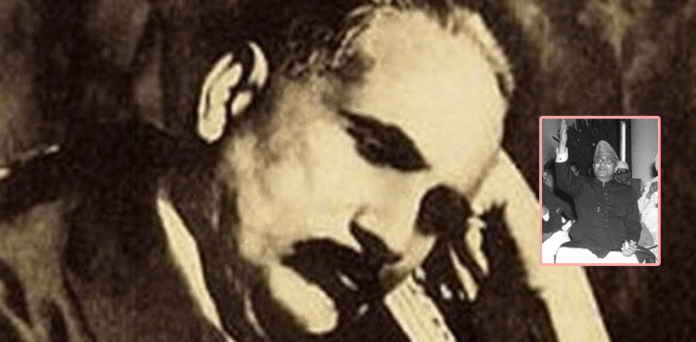
Allama Iqbal: The Poet of the East
Born in Sialkot in 1877, Allama Iqbal is revered as Pakistan’s national poet and a visionary who articulated the idea of a separate Muslim homeland. His works, such as Bang-e-Dra and Asrar-e-Khudi, blend poetry, philosophy, and Islamic thought, inspiring generations to embrace selfhood and spirituality. Beyond his intellectual contributions, Iqbal’s personal life was marked by a deep emotional connection to his faith, which often manifested in moments of profound sensitivity.
Iqbal’s later years, particularly the final third of his life, were defined by a turning inward. As Agha Shorish records in his writings, quoting Abdul Majeed Salik, Iqbal had withdrawn from worldly distractions, his heart consumed by devotion. The mere mention of the Prophet Muhammad (PBUH) would send shivers through his body, and he would often be moved to tears. This story of the hadith about a cat in Masjid Nabawi offers a glimpse into the soul of a man whose intellectual rigor was matched by his emotional depth.
The Hadith That Moved Iqbal to Tears
The incident, as narrated by Salik to Shorish, occurred during a conversation where Salik shared a hadith about the Prophet Muhammad (PBUH). The hadith describes an episode in Masjid Nabawi, the Prophet’s mosque in Madinah, where a cat had given birth to kittens. Some of the Prophet’s companions (Sahaba) suggested killing or driving the cat away, citing concerns that it was defiling the sacred space. The Prophet (PBUH), with his boundless compassion, forbade them, saying, “Do not kill her; she has become a mother.” He instructed them to leave the cat undisturbed, recognizing the sanctity of motherhood.
Upon hearing this hadith, Iqbal was overcome with emotion. Salik recounts that Iqbal broke into sobs, his body trembling as he wept uncontrollably for nearly three-quarters of an hour. “Do not kill her; she has become a mother—Allah, Allah, what honor in motherhood?” Iqbal exclaimed, his voice choked with tears. The depth of the Prophet’s mercy, extending even to a humble animal, struck a chord in Iqbal’s heart, reflecting his own reverence for life and compassion.
Salik, witnessing Iqbal’s reaction, was initially alarmed, fearing he had caused distress. He described feeling as though he had committed a grave mistake, shaken by the intensity of Iqbal’s tears. Only when Iqbal regained his composure did Salik find relief, realizing the poet’s response was not one of pain but of profound spiritual connection.
The Context: Iqbal’s Spiritual Evolution
Iqbal’s reaction to the hadith reflects the spiritual transformation that defined his later years. By the 1930s, as he approached his sixties, Iqbal had grown increasingly introspective. His poetry from this period, including works like Zarb-e-Kaleem, reveals a man grappling with the state of the Muslim ummah and seeking divine guidance. His heart, as Salik noted, was in a state of constant tenderness, particularly when it came to matters of faith.
The hadith about the cat resonated with Iqbal because it encapsulated the Prophet’s (PBUH) mercy, a central theme in Islam that Iqbal championed in his philosophy. His concept of khudi (selfhood) emphasized human dignity and compassion, values mirrored in the Prophet’s gentle treatment of the cat. For Iqbal, this story was not just about an animal but about the universal sanctity of life, a principle he wove into his vision for a revitalized Muslim community.
The Storytellers: Abdul Majeed Salik and Agha Shorish
The anecdote comes to us through two literary giants of Urdu: Abdul Majeed Salik and Agha Shorish Kashmiri. Salik, a prominent journalist and writer, was known for his eloquent prose and deep connection to Iqbal. His works, such as Zikr-e-Iqbal, offer intimate insights into the poet’s life. Agha Shorish, a fiery orator and editor of the influential Chattan magazine, was equally renowned for his mastery of Urdu literature and journalism. His retelling of Salik’s story in his writings preserves this touching moment for posterity.
Both men were contemporaries of Iqbal, and their accounts lend authenticity to the narrative. Shorish’s vivid description captures the raw emotion of the moment, while Salik’s firsthand experience adds credibility. Their combined legacy ensures that Iqbal’s humanity remains a beacon for readers today.
Why This Story Matters in 2025
In 2025, as Pakistan navigates modern challenges, Iqbal’s story resonates deeply. His emotional response to the hadith underscores the timeless relevance of compassion in Islam, a value that can guide societies through division and conflict. The Prophet’s (PBUH) mercy toward a mother cat reflects a broader ethic of care that Iqbal sought to instill in the Muslim ummah—a call to honor all life, human and animal alike.
This anecdote also highlights Iqbal’s role as a bridge between intellect and emotion. In an era of rapid technological advancement, from Saudi Arabia’s Humain Chat AI to global nuclear debates, Iqbal’s example reminds us to balance progress with empathy. For Pakistanis, his legacy inspires a return to spiritual roots, fostering unity and kindness in a polarized world.
Lessons from Iqbal’s Tears
Iqbal’s reaction offers several lessons for today’s readers:
- Compassion as a Core Value: The hadith reflects Islam’s emphasis on mercy, a principle Iqbal lived by. In 2025, this encourages us to extend kindness to all beings, from neighbors to animals.
- Emotional Authenticity: Iqbal’s unashamed tears show that strength lies in vulnerability. Leaders and individuals alike can embrace emotional honesty as a source of connection.
- Spiritual Connection: Iqbal’s devotion to the Prophet (PBUH) reminds Muslims to deepen their bond with Islamic teachings, finding inspiration in small acts of mercy.
- Legacy of Literature: The storytelling of Salik and Shorish underscores the power of Urdu literature to preserve history and inspire future generations.
Cultural and Spiritual Significance
For Pakistan, Iqbal is more than a poet; he is a symbol of identity and aspiration. This story, set against the backdrop of Masjid Nabawi, connects Pakistanis to their spiritual heritage, especially as millions undertake Umrah and Hajj each year. It also resonates with global Muslims, reinforcing the universal appeal of the Prophet’s (PBUH) compassion.
In educational settings, this anecdote can be taught alongside Iqbal’s poetry to highlight his humanity. It also aligns with Pakistan’s efforts to promote interfaith harmony and environmental stewardship, as compassion for animals is a shared value across cultures.
How to Reflect on This Story
To honor Iqbal’s legacy, consider these actions:
- Read the Hadith: Study the story of the cat in Masjid Nabawi to appreciate the Prophet’s (PBUH) mercy. Share it with family or community groups.
- Explore Iqbal’s Works: Dive into Bang-e-Dra or Asrar-e-Khudi to connect with his spiritual and philosophical insights.
- Practice Compassion: Volunteer for animal welfare or community service, embodying the values Iqbal cherished.
- Engage in Dialogue: Discuss this story in schools, mosques, or online forums to inspire others with Iqbal’s example.
Final Thoughts
The story of Allama Iqbal weeping over a hadith is a testament to his profound spirituality and compassion. It humanizes a towering figure, showing that even the greatest minds are moved by simple acts of kindness. In 2025, as we navigate a complex world, Iqbal’s tears remind us to hold fast to mercy and empathy, values that transcend time and place. This tale, preserved through the words of Salik and Shorish, continues to inspire Pakistanis and Muslims worldwide to live with heart and purpose.
What does this story of Iqbal mean to you? Share your reflections in the comments below! For more insights on literature, spirituality, and history.
This article is brought to you by Mehru Blogs. For more Visit www.mehrublogs.com.
Contact us at mehrublogs@gmail.com.
Follow us on social media: Facebook | Instagram.
