

HPV Vaccine in Pakistan: Debunking Objections to Save Lives from Cervical Cancer
There have been some diseases in human history that have raised questions about the existence of the human race. Cancer is still the most terrifying of them. But science has given man the message that even in the dark, a lamp can be lit.
One of these lights is the HPV vaccine (Human Papillomavirus Vaccine), which can be called “Human Papillomavirus Protective Medicine” in Urdu. This vaccine is a great achievement in today’s scientific world for protecting the lives and health of women, especially.
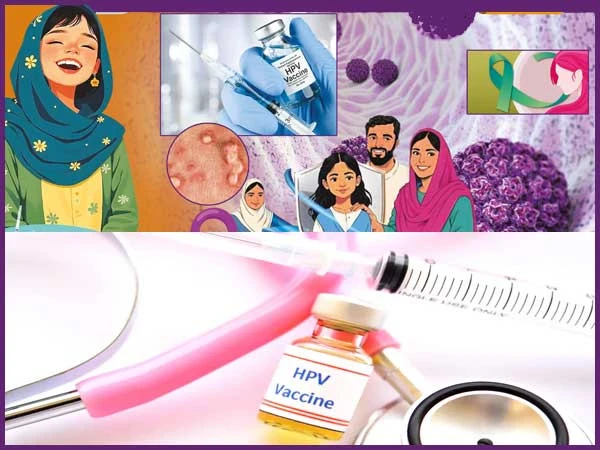
Global research and innovation
The HPV vaccine was first developed in the 1990s when Australian scientist Professor Ian Frazer and his colleague Jian Zhou developed virus-like particles. These particles do not spread the disease but prepare the body for an immune response. It was first introduced in the US in 2006 as Gardasil, followed by more effective versions such as Cervarix and Gardasil 9.
According to the World Health Organization (WHO) and the US Centers for Disease Control (CDC), the vaccine prevents about 70% to 90% of cervical cancer cases in women. In countries such as Australia, the UK and Norway, this vaccination program has been so successful that the rate of cervical cancer among young people has been reduced by more than half.
Need in Pakistan
In Pakistan, about 5,000 women suffer from cervical cancer every year, while the mortality rate is close to 60%, because the disease is usually diagnosed late. This disease is not limited to women alone, but also affects the survival of the family, the upbringing of children and the moral structure of society. In such a situation, the use of HPV vaccine seems inevitable.
Moreover, global research has proven that HPV is not only a threat to women but also to men. The virus can cause cancer of the mouth, throat and genitals in men. Significant protection against it has also been seen in men after vaccination in the United States and Europe.
Social and religious barriers
There are several obstacles to the promotion of this vaccine in Pakistan.
Some quarters call it a Western conspiracy and oppose it on religious grounds.
There is also a fear among parents that this vaccine will promote sexual freedom among the youth.
Due to ignorance and lack of knowledge, it is often considered unnecessary or unsafe.
The position of Islamic countries and scholars
Some Islamic countries have not only implemented HPV vaccination programs, but scholars have also declared it permissible under Islamic law. For example, in Malaysia, in 2010, the Jabatan Kemajuan Islam Malaysia (JAKIM) issued an official fatwa stating that HPV vaccination is “permissible” to prevent cervical cancer if the vaccine does not contain any questionable ingredients and is not harmful.
Similarly, the United Arab Emirates (UAE) included the HPV vaccine in its national immunization program in 2018, and its National Immunization Technical Advisory Group supported it at the government level.
Furthermore, public attitudes and research in the Saudi Arabian province of Jazan showed that medical and religious arguments made the use of vaccines acceptable, despite religious concerns.
These examples are proof that the protection of human life is a top priority in Islam, and when a medicine is a means of saving life, its use can be considered not only permissible but almost obligatory.
The HPV vaccine is not just a medical invention and necessity for Pakistani society today, but also a guarantee of women’s lives and social survival. If the government includes it in regular programs like other means of national immunization, thousands of lives can be saved every year. For this, it is necessary to remove social and religious misconceptions by taking into account data, research and global experiences.
Note: MehruBlogs and its policies do not necessarily agree with the views of this blogger.
Stay updated on Gulf migration trends at www.mehrublogs.com or email mehrublogs@gmail.com.
Follow us on social media:
The Human Papillomavirus (HPV) vaccine stands as a beacon of hope in the fight against cervical cancer, a disease that claims thousands of lives in Pakistan annually. Despite its proven efficacy—reducing cervical cancer cases by up to 90% in countries like Australia—this life-saving tool faces fierce resistance in Pakistan. Some label it a “Western conspiracy,” while others raise religious and moral objections, fearing it promotes promiscuity.
Yet, Islamic scholars in Malaysia and the UAE have endorsed its use, and global data underscores its necessity. In 2025, as Pakistan grapples with 5,000 new cervical cancer cases yearly, the HPV vaccine Pakistan debate is more urgent than ever. This article dives into the vaccine’s science, global triumphs, religious approvals, and why overcoming misconceptions is critical for women’s health Pakistan.
Cervical cancer isn’t just a medical issue; it disrupts families and communities, with a 60% mortality rate in Pakistan due to late diagnoses. Drawing from Kaush Siddiqui’s September 18, 2025, analysis and WHO insights, we’ll explore how the HPV vaccine can transform lives, counter objections, and pave the way for a national immunization program. For women, families, and policymakers, understanding this vaccine’s potential is a step toward a healthier future.
The Science Behind the HPV Vaccine: A Medical Marvel
Developed in the 1990s by Australian scientists Ian Frazer and Jian Zhou, the HPV vaccine uses virus-like particles to trigger immunity without causing disease. Introduced as Gardasil in 2006, followed by Cervarix and Gardasil 9, it targets HPV strains (like 16 and 18) responsible for 70-90% of cervical cancer cases, per WHO and CDC data. It also protects against cancers of the throat, mouth, and reproductive organs in men, making it a universal shield.
In countries like Australia, the UK, and Norway, vaccination programs slashed cervical cancer rates by over 50% among young women. For instance, Australia’s 2007 rollout led to a 90% drop in HPV infections by 2020. Administered ideally between ages 9-15, before HPV exposure, the vaccine is safe, with over 270 million doses given globally and side effects (mild fever, soreness) in under 1% of cases.
In Pakistan, where cervical cancer is the third most common cancer among women, the vaccine’s impact could be transformative. With 5,000 annual cases and 3,000 deaths, early vaccination could prevent thousands of tragedies, sparing families the emotional and economic toll of late-stage diagnoses.
Why Pakistan Needs the HPV Vaccine Now
Pakistan’s cervical cancer burden is stark: 5,000 new cases yearly, with a 60% mortality rate due to late detection, per local health studies. Rural areas, lacking screening, bear the brunt—70% of cases are diagnosed at stage III or IV. The HPV vaccine Pakistan could shift this, offering prevention over costly treatment (chemo costs up to PKR 500,000 per patient).
Beyond women, HPV poses risks to men, causing 10% of throat and penile cancers globally. Vaccinating boys, as seen in the UK, cuts transmission, amplifying herd immunity. In Pakistan, where healthcare access is uneven, a national HPV program could save billions in treatment costs while protecting entire communities.
The vaccine’s necessity extends beyond health. Cervical cancer disrupts family structures—mothers lost, children orphaned, and communities strained. As Kaush Siddiqui notes, “This disease affects not just women but the moral fabric of society.” A proactive vaccination drive aligns with Pakistan’s health goals, like reducing maternal mortality under SDG 3.
Objections to the HPV Vaccine: Myths vs. Reality
Despite its benefits, the HPV vaccine faces resistance in Pakistan:
- “Western Conspiracy” Claims Some groups brand the vaccine a foreign plot to harm Muslim populations or reduce fertility. Fact: Over 100 countries, including Islamic nations like Malaysia and UAE, use it safely. WHO confirms no fertility risks, with studies showing vaccinated women have normal birth rates.
- Religious and Moral Concerns Critics argue it encourages sexual promiscuity by protecting against an STI. Counterpoint: The vaccine prevents cancer, not morality—administered to pre-teens before sexual activity. Malaysia’s JAKIM issued a 2010 fatwa deeming it “mubah” (permissible) if free of haram ingredients, echoed by UAE scholars in 2018.
- Lack of Awareness Misinformation fuels fears of side effects or irrelevance. Education campaigns, like those in Saudi Arabia’s Jazan province, doubled acceptance rates by 2023, showing community outreach works.
These objections stem from cultural sensitivities and low health literacy. Yet, Islamic endorsements and global success stories—like UAE’s national HPV program since 2018—prove acceptance is possible with clear communication.
Islamic Perspectives: Aligning Faith with Science
Islamic scholars have increasingly supported the HPV vaccine. Malaysia’s JAKIM fatwa clarified its permissibility, emphasizing life preservation—a core Islamic tenet. UAE’s 2018 inclusion in national programs, backed by its advisory group, saw 80% coverage among teens by 2024. In Saudi Arabia, Jazan’s campaigns overcame religious hesitancy through imam-led talks, achieving 65% uptake.
Pakistan’s scholars, like those at Darul Uloom Karachi, could follow suit, issuing fatwas to clarify the vaccine’s halal status (Gardasil uses no pork derivatives). The Quran’s emphasis on protecting life (Surah Al-Ma’ida 5:32) supports vaccination as near-obligatory when it saves thousands. Engaging local mosques and madrasas, as UAE did, could bridge faith-science gaps.
Overcoming Barriers: A Path Forward for Pakistan
To integrate the HPV vaccine Pakistan into national programs, several steps are critical:
- Public Awareness Campaigns: Use TV, social media (X, Instagram), and community leaders to debunk myths. Highlight success stories from Muslim countries. A 2024 UAE campaign increased uptake by 40% via influencer partnerships.
- Subsidized Access: At PKR 10,000-15,000 per dose (three needed), cost is a hurdle. Government subsidies, like polio drives, could make it free for girls aged 9-15, targeting 1 million annually.
- School-Based Programs: Follow Australia’s model, vaccinating at schools for 90% coverage. Pilot in Punjab and Sindh, where 60% of cases occur.
- Engaging Religious Leaders: Partner with ulema for fatwas and sermons, mirroring Malaysia’s JAKIM approach. A 2023 Saudi study showed 70% attitude shifts post-religious endorsements.
Pakistan’s polio campaign, reaching 40 million kids yearly, proves scalability. Adding HPV to this framework could save 3,000 lives annually by 2035, per WHO projections.
Challenges and Criticisms: Addressing the Pushback
Resistance isn’t just cultural—logistics pose issues. Rural clinics lack cold storage for vaccines, and only 30% of Pakistani women access regular screenings. Training health workers and expanding mobile units could bridge this gap. Critics also fear “over-medicalization,” but global data shows HPV vaccination reduces cancer rates without promoting risky behavior.
Skeptics on X argue the vaccine distracts from broader healthcare gaps, like oncology funding. Yet, prevention is cheaper—PKR 45,000 for three doses versus PKR 1 million for cancer treatment per patient. Balancing immediate care with long-term prevention is key.
Global Context: A Model for Pakistan
Countries like Rwanda, with 93% HPV coverage by 2024, show low-income nations can succeed. Their secret? Government commitment, donor funding (e.g., GAVI), and school campaigns. Pakistan, with GAVI support, could replicate this, targeting 50% coverage by 2030.
In 2025, as cervical cancer remains a global killer (342,000 deaths yearly), Pakistan’s hesitation costs lives. Aligning with Islamic allies like UAE and Malaysia could normalize the vaccine, making it a cultural asset, not a conspiracy.
Conclusion: A Lifeline for Pakistan’s Women
The HPV vaccine Pakistan isn’t just a medical tool—it’s a lifeline for 5,000 women facing cervical cancer annually. By debunking “Western conspiracy” myths and leveraging Islamic endorsements, Pakistan can save lives and strengthen families. From Australia’s success to UAE’s fatwas, the path is clear: Embrace science with faith.
HPV vaccine Pakistan, cervical cancer prevention, HPV vaccine objections, Islamic stance HPV vaccine, women’s health Pakistan
HPV vaccine Pakistan, cervical cancer prevention, HPV vaccine objections, Islamic stance HPV vaccine, women’s health Pakistan
