
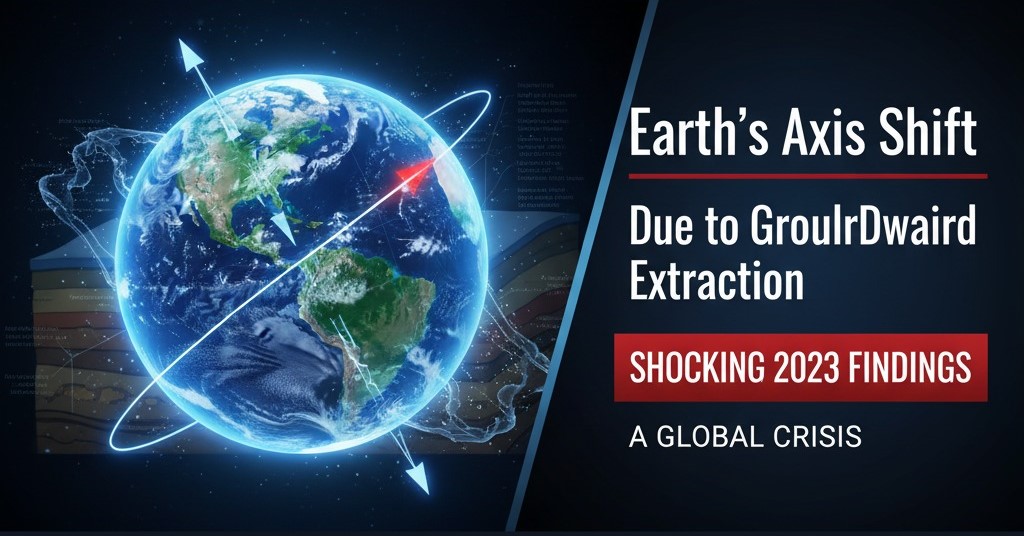
In a startling revelation, a 2023 study published in Nature uncovered that humanity’s relentless extraction of groundwater is literally tilting the Earths axis. Between 1993 and 2010, the planet’s axis, around which it spins like a top, shifted approximately 31.5 inches (80 centimeters) southeast from the North Pole. This shift, driven by excessive groundwater use for agriculture, cities, and industries, is disrupting the Earth’s mass balance and subtly altering its rotation. The consequences are profound, affecting climate patterns, seasons, and even glacier melting. This article explores the science behind this phenomenon, its implications for Pakistan and the world, and urgent steps needed to address this environmental crisis.
Why Is Earth’s Axis Shifting?
The Earth spins on an imaginary axis, a line connecting the North and South Poles. This axis determines the length of our days and the cycle of seasons. The 2023 Nature study, corroborated by research in Science Advances, revealed that extracting vast amounts of groundwater—over 2,150 gigatons from 1993 to 2010—has redistributed the planet’s mass. This is akin to removing weight from one side of a spinning top, causing it to wobble.
Groundwater, stored in underground aquifers, is a critical resource for drinking, irrigation, and industrial use. However, humanity’s overexploitation, particularly in water-stressed regions like Pakistan, India, and the Middle East, has depleted these reserves at an alarming rate. When groundwater is pumped out, it flows into rivers and oceans, shifting the Earth’s mass toward the equator. This redistribution has caused the axis to tilt southeast, with measurable impacts on the planet’s rotation.
How Groundwater Extraction Impacts the Planet
The shift in Earth’s axis is not just a scientific curiosity—it has real-world consequences. Here’s how it affects the environment and human life:
1. Altered Climate Patterns
The axis shift influences the distribution of solar energy across the globe, subtly changing climate patterns. The Science Advances study noted that this shift contributes to longer, more intense summers and reduced snowfall in regions like the Arctic. In Pakistan, where monsoon rains and heatwaves are already extreme, these changes could exacerbate flooding and drought cycles.
2. Rising Sea Levels
Depleted groundwater eventually reaches the oceans, contributing to sea level rise. The Nature study estimates that groundwater extraction alone raised global sea levels by 0.24 inches (6 millimeters) between 1993 and 2010. For low-lying areas like Pakistan’s coastal city of Karachi, this increases the risk of flooding and saltwater intrusion into farmland.
3. Disrupted Seasons
The tilt in Earth’s axis affects the timing and intensity of seasons. In Pakistan, where agriculture depends on predictable monsoons, prolonged summers and erratic rainfall threaten crop yields. Farmers in Punjab and Sindh, who rely on groundwater for irrigation, are unknowingly contributing to this global shift.
4. Accelerated Glacier Melting
The axis shift amplifies the effects of global warming, driven by greenhouse gases like carbon dioxide and methane. As the Earth’s mass balance changes, glaciers in regions like the Himalayas, which feed Pakistan’s rivers, are melting faster. This threatens water security for millions in South Asia.
Pakistan’s Role in the Crisis
Pakistan is among the world’s top groundwater extractors, with over 70% of its water used for agriculture. The Indus Basin, one of the largest aquifer systems, is under severe stress due to over-pumping for crops like rice and wheat. The Nature study highlights regions like South Asia as key contributors to the axis shift, placing Pakistan at the heart of this issue.
In cities like Lahore and Karachi, groundwater depletion is compounded by urban demand and poor water management. Pakistan’s per capita water availability has dropped below 1,000 cubic meters, classifying it as a water-scarce nation. The environmental toll is evident in sinking land (subsidence) in areas like Quetta and the depletion of wells in rural Sindh.
The Bigger Picture: Global Warming and Environmental Stress
While groundwater extraction directly causes the axis shift, it’s intertwined with global warming. Greenhouse gas emissions, primarily from fossil fuels, drive temperature increases that intensify droughts, forcing reliance on groundwater. The Science Advances study warns that this creates a vicious cycle: more groundwater extraction leads to greater environmental disruption, which further strains water resources.
The study also draws parallels with other human-induced changes, like deforestation and dam construction, which alter the Earth’s mass balance. For instance, India’s release of dam water during monsoons, as noted in related environmental discussions, exacerbates flooding in Pakistan, compounding the effects of groundwater depletion.
What Can Be Done to Mitigate the Crisis?
The Nature study’s findings are a wake-up call for global action. Here are practical steps for Pakistan and the world to address groundwater depletion and its planetary impacts:
-
Sustainable Water Management:
-
Implement efficient irrigation techniques like drip irrigation to reduce groundwater use in agriculture.
-
Promote rainwater harvesting to recharge aquifers, especially in rural Pakistan.
-
Regulate groundwater extraction through permits and monitoring, as seen in parts of Australia. (Earths Axis Shift)
-
-
Public Awareness Campaigns:
-
Educate communities about the link between groundwater use and environmental impacts. In Pakistan, campaigns in Urdu and regional languages could reach farmers and urban residents.
-
Highlight the importance of conserving water at home, such as fixing leaks and using water-saving appliances.
-
-
Policy Reforms:
-
Enforce stricter regulations on industrial water use, particularly in water-intensive sectors like textiles in Pakistan.
-
Invest in infrastructure to recycle wastewater, reducing reliance on groundwater.
-
Collaborate with neighboring countries like India to manage shared water resources, such as the Indus River.
-
-
Global Cooperation:
-
Support international agreements to limit greenhouse gas emissions, addressing the root cause of climate-driven water scarcity.
-
Fund research into alternative water sources, like desalination, to ease pressure on aquifers.
-
-
Community Action:
-
Encourage local initiatives, like tree planting, to stabilize soil and reduce evaporation.
-
Engage religious and community leaders in Pakistan to promote water conservation as a moral duty, aligning with Islamic principles of stewardship.
-
A Call to Action for Pakistan and Beyond
The Nature study underscores that Earth’s “mood” is changing, and humanity is to blame. For Pakistan, a country already battling water scarcity, floods, and heatwaves, the axis shift is a stark reminder of the need for urgent action. By adopting sustainable practices and raising awareness, Pakistan can lead by example in protecting the planet.
Globally, the findings resonate with broader environmental challenges, such as those highlighted in discussions about Gaza’s humanitarian crisis, where resource scarcity fuels conflict. Just as nations like Turkey advocate for justice, Pakistan must champion water conservation to ensure a livable future.
What steps will you take to conserve water and protect our planet? Share your ideas in the comments below! For more environmental insights and sustainable living tips.
This article is brought to you by Mehru Blogs. For more Visit www.mehrublogs.com.
Contact us at mehrublogs@gmail.com.
Follow us on social media: Facebook | Instagram. (Earths Axis Shift)
